
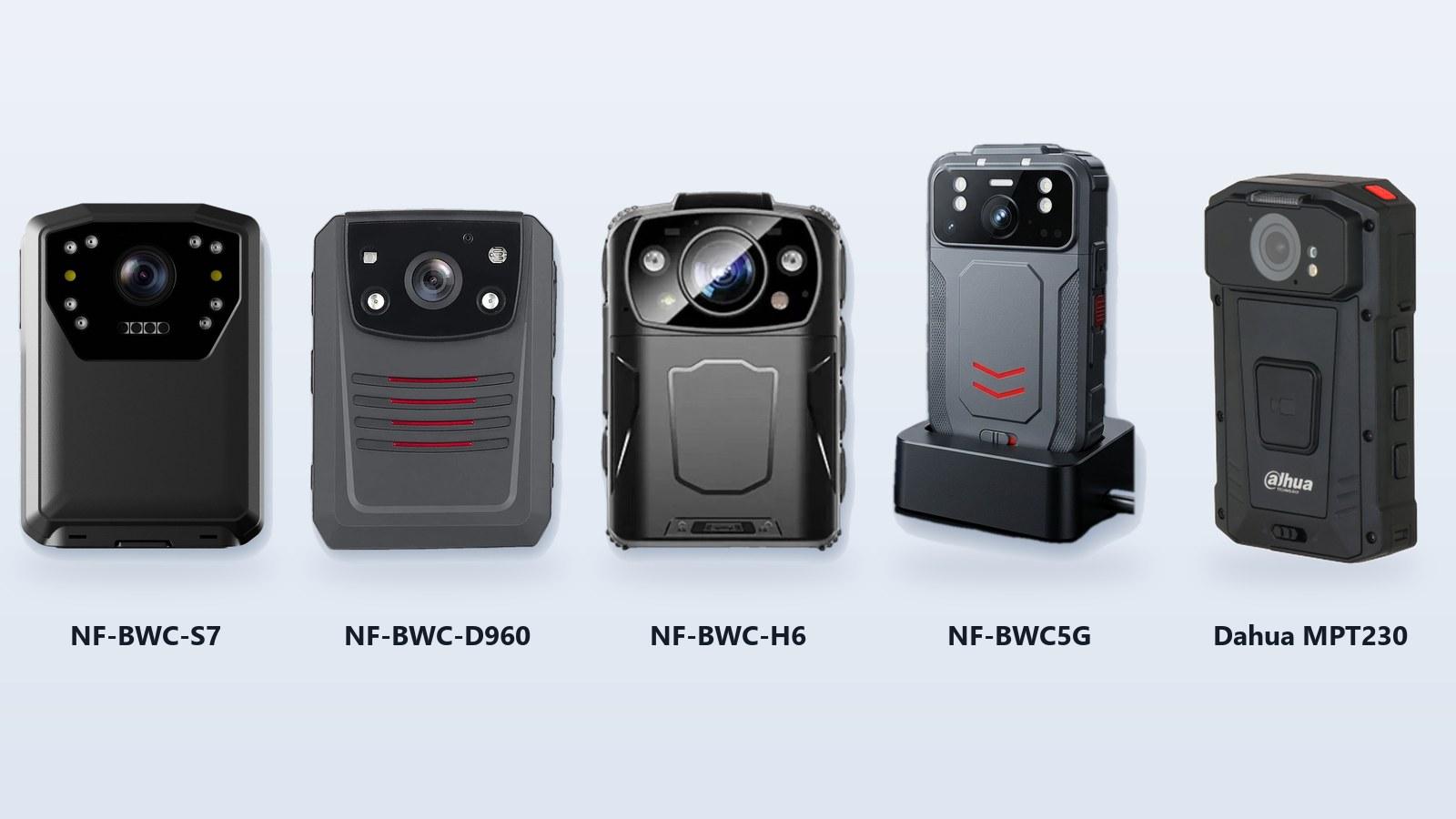
First, to be clear: this is a spec comparison, not a hands-on test
This article is New Forward's spec comparison with buying notes. Specifications for NF-BWC-S7, NF-BWC-D960 and NF-BWC-H6 are manufacturer-stated first-edition data, and the actual product prevails; figures for NF-BWC5G and Dahua MPT230 come from their published specifications. Every endurance, night-vision and similar figure here is as stated by the manufacturer or the published specification, and New Forward has not tested the three entry-level models hands-on. For the full spec table, see the body-worn camera model comparison.
Step one: how does footage get from the camera to the office?
The biggest difference between body-worn cameras is not the lens but how footage is handed over. The five models fall into three ways of working:
| Way of working | Models | Where footage goes | Ongoing costs |
|---|---|---|---|
| Local recording | NF-BWC-S7, NF-BWC-D960, NF-BWC-H6 | Stored on the memory card in the camera and copied to a computer by USB or card after the shift | No SIM card, no platform fee |
| 4G live | NF-BWC5G | Sent to the office in real time over 4G and the management platform; can also be used standalone without a SIM | Data SIM (provided by the customer) and platform services |
| On-site archiving | Dahua MPT230 with EEC400-D | Docked in the data collection station after the shift to download and charge automatically; footage stays on site | No SIM in the base setup; live functions need the DSS platform |
To choose, ask three questions. Does the office need to see front-line video or know where staff are in real time? Must footage be kept centrally on site and managed by designated staff? Or is the aim to meet the contract clauses at the lowest outlay, with staff copying and keeping footage themselves? Common public works clauses do not ask for 4G or live viewing (see body-worn camera demand in Hong Kong (2026)), so don't assume from the start that you need 4G.
Will it last a shift? How to read battery figures
Contracts commonly ask for at least 9 hours of continuous 1080p 30 fps recording on one fully charged battery. The stated figures for the five models:
| Model | Battery | Continuous recording (stated) |
|---|---|---|
| NF-BWC-S7 | 2 × 2200 mAh removable, hot-swap | About 9 h per battery, 18 h or more with both (manufacturer-stated) |
| NF-BWC-D960 | Built-in 3200 mAh | About 17 h at 1080P; about 8 h with infrared on in darkness (manufacturer-stated) |
| NF-BWC-H6 | 2 × 2000 mAh removable, hot-swap | About 9 h per battery at 1080P30 (manufacturer test at 25 °C), up to 18 h with both (manufacturer-stated) |
| NF-BWC5G | 3050 mAh removable, plus a built-in backup cell | 9+ h at 1080p on one battery |
| Dahua MPT230 | 3200 mAh removable, hot-swap | Up to 11.5 h at 1080p (measured in flight mode with lights and screen off) |
Three things to watch when reading these figures:
- Conditions differ: some figures were measured at a set resolution or temperature, or with all lights and the screen off. Cold or hot weather, night vision, the screen or 4G all shorten real-world times.
- One battery or two: the manufacturer states about 9 hours per battery for NF-BWC-S7; to be on the safe side, plan to hot-swap in the second battery mid-shift when recording for 9 hours or more (recording continues during the change). The NF-BWC-H6 single-battery figure is about 9 hours in the manufacturer's test. NF-BWC-D960 runs on one built-in 3200 mAh battery, stated by the manufacturer at about 17 hours at 1080P, or about 8 hours with infrared on in darkness.
- Does a battery change stop recording? NF-BWC-S7 and NF-BWC-H6 support hot-swap; NF-BWC5G has a built-in backup cell so it stays on during a swap; and Dahua MPT230 gives about 5 minutes of buffer power.
Is 256 GB enough? Storage versus retention
Going by the manufacturers' storage tables, 256 GB holds about 55–60 hours of 1080p video, roughly 7 working days of 8 hours; at 1440P or higher you get fewer hours.
Keep two things apart: how long a memory card can record is not the same as the contract's "keep for 7 days". NF-BWC-D960 uses loop recording, overwriting the oldest footage when the card is full, so footage from local recording models needs to be copied off regularly. NF-BWC5G can upload automatically with resume, and Dahua MPT230 is docked in the EEC400-D data collection station, which has 4 hard-disk bays (up to 16 TB per disk). As for storage on the camera: New Forward supplies a 256 GB memory card with each of the three entry-level models; NF-BWC5G has 32 GB built in as standard, with 64 GB or 256 GB available; and Dahua MPT230 has 64 GB built in, expandable to 256 GB.
Weight, water resistance and night vision: beyond the contract clauses
- Weight: NF-BWC-H6 112 g (without clip), NF-BWC-S7 123 g, NF-BWC-D960 about 135 g (entry-level figures manufacturer-stated), NF-BWC5G 177 g and Dahua MPT230 183 g, all under the common 400 g contract limit. Worn on the chest for a whole shift, a few grams make a difference.
- Water and dust: NF-BWC-S7 and NF-BWC-D960 IP66 with a 2.5 m drop test; NF-BWC-H6 IP66 with a 2 m drop test (entry-level figures manufacturer-stated); NF-BWC5G IP68 with a 2 m drop test; Dahua MPT230 IP68 with 2 m drop tests on four sides. If a contract specifies an IP rating, check it item by item.
- Night vision: stated face-identification distances range from about 3 m to about 7 m and are measured differently for each model, so think about your actual working environment (tunnels, basements, night shifts).
- Lens: wide angles range from 110° to 160°. A wider angle covers more of the scene but distorts the edges of the picture.
Data protection: who can see the footage?
NF-BWC5G and Dahua MPT230 encrypt recordings with AES-256, and NF-BWC-S7 and NF-BWC-D960 have password protection. Once footage from a local recording model is copied to a computer, keeping it safe is up to the organisation: set account permissions on the computer, limit who can view and delete footage, and keep a log of hand-overs.
Public works contracts commonly require a bilingual recording notice on the camera, and New Forward supplies a bilingual recording-notice label and a chest/shoulder harness with each of the three entry-level models. For the privacy rules on notices, retention and access requests, see body-worn camera demand in Hong Kong (2026).
How to think about budget (no prices)
We do not list prices on the website, but budgets broadly fall into three tiers:
- Entry: local recording models, mainly the cameras and memory cards, with no SIM or platform fees.
- Mid: the 4G live model, which adds ongoing costs for data SIMs (provided by the customer) and platform services on top of the cameras; it can also start without the platform and be used standalone.
- High: on-site archiving, adding the data collection station and hard disks, plus the DSS platform if live functions are needed, with a data SIM per camera (provided by the customer).
Quantity, battery configuration, retention period and platform choice all affect the budget. Send us the number of cameras and the specification annex of your contract and we can quote against the specification.
How New Forward helps you check a contract specification
New Forward is a Hong Kong system integrator. We can reply to your specification annex item by item, showing how each model addresses each clause, and we provide local warranty and operator training in Hong Kong. New Forward does not arrange 4G SIM cards; data SIMs are always provided by the customer.