
Why is demand for body-worn cameras rising in Hong Kong in 2026?
The most direct reason is public works. According to a paper submitted to the Legislative Council by the Development Bureau, the Labour and Welfare Bureau and the Labour Department, since June 2026 the Development Bureau has required the front-line personnel of resident site staff and of contractors on all public works contracts to wear body-worn video cameras during site inspections, to strengthen site supervision, safety management, quality control and works progress monitoring. The paper also notes that body-worn cameras have become increasingly common in construction as the technology has matured (LegCo paper CB(1)749/2026(02), para 40). The Secretary for Development also mentioned the new requirement in a written reply to the Legislative Council on 24 June 2026 (LCQ13). Public works are large in scale, too: the Government estimates capital works expenditure at about HK$128 billion in 2026-27, staying at a similar level in the following years (2026-27 Budget), so the requirement covers a great deal of work and many front-line staff.
Official Chinese documents call them 穿戴式攝錄機 or 穿戴式攝影機, while the Police and other departments use 隨身攝錄機. In English the term is body-worn video camera (BWVC), and people also say body cam. They all mean the same kind of chest-mounted, one-press camera.
The same LegCo paper gives the background: construction industrial accidents fell 20.2% from 3,037 in 2024 to 2,425 in 2025, but fatal cases rose from 14 to 21. Site safety and supervision remain a government priority, and video records are one of the tools. TVB News also reported on 10 November 2026 that the Development Bureau will require photo and video records before and after construction works, so the expectation of video evidence on site looks set to grow.
The public works BWVC requirement: who wears them, and when?
- Who: the front-line personnel of resident site staff (RSS) and of contractors on all public works contracts. Resident site staff are posted to site by the works department or its consultant to supervise the works, check them against the approved drawings and method statements, and keep inspection records.
- When: during site inspections.
- Since: June 2026.
- Relation to 4S: the body-worn camera requirement is not an element of the Smart Site Safety System (4S), but it is another form of technology-based site monitoring. 4S itself has applied to public works contracts over HK$30 million since February 2023; see our 4S requirements guide.
The official documents say nothing about device specifications, retention periods or privacy arrangements; those details sit in each contract's specification annex.
What do contracts commonly specify for body-worn cameras?
We have not found a single standard specification published by the Development Bureau. The table below lists clauses we commonly see in the body-worn camera particular specification of public works contracts; individual contracts may differ, and the specification annex of your own contract prevails.
| Item | Common requirement |
|---|---|
| Body weight | ≤ 400 g |
| Storage | ≥ 256 GB (built-in or microSD), enough for continuous recording and 7 days of 1080p footage |
| Recording | 1080p 30 fps or higher with audio, date/time watermark, able to record in low light |
| Battery | ≥ 9 hours of continuous 1080p 30 fps recording on one fully charged battery |
| Wearing | Adjustable chest or shoulder strap |
| Notice | A conspicuous bilingual notice on or beside the camera: "Video & Audio Recording In Progress 錄影及錄音現正進行中" |
| Retention | Footage kept securely for ≥ 7 days and provided within 24 hours when designated staff ask for it |
| Privacy | Compliance with the Personal Data (Privacy) Ordinance and PCPD guidance; all footage deleted on completion |
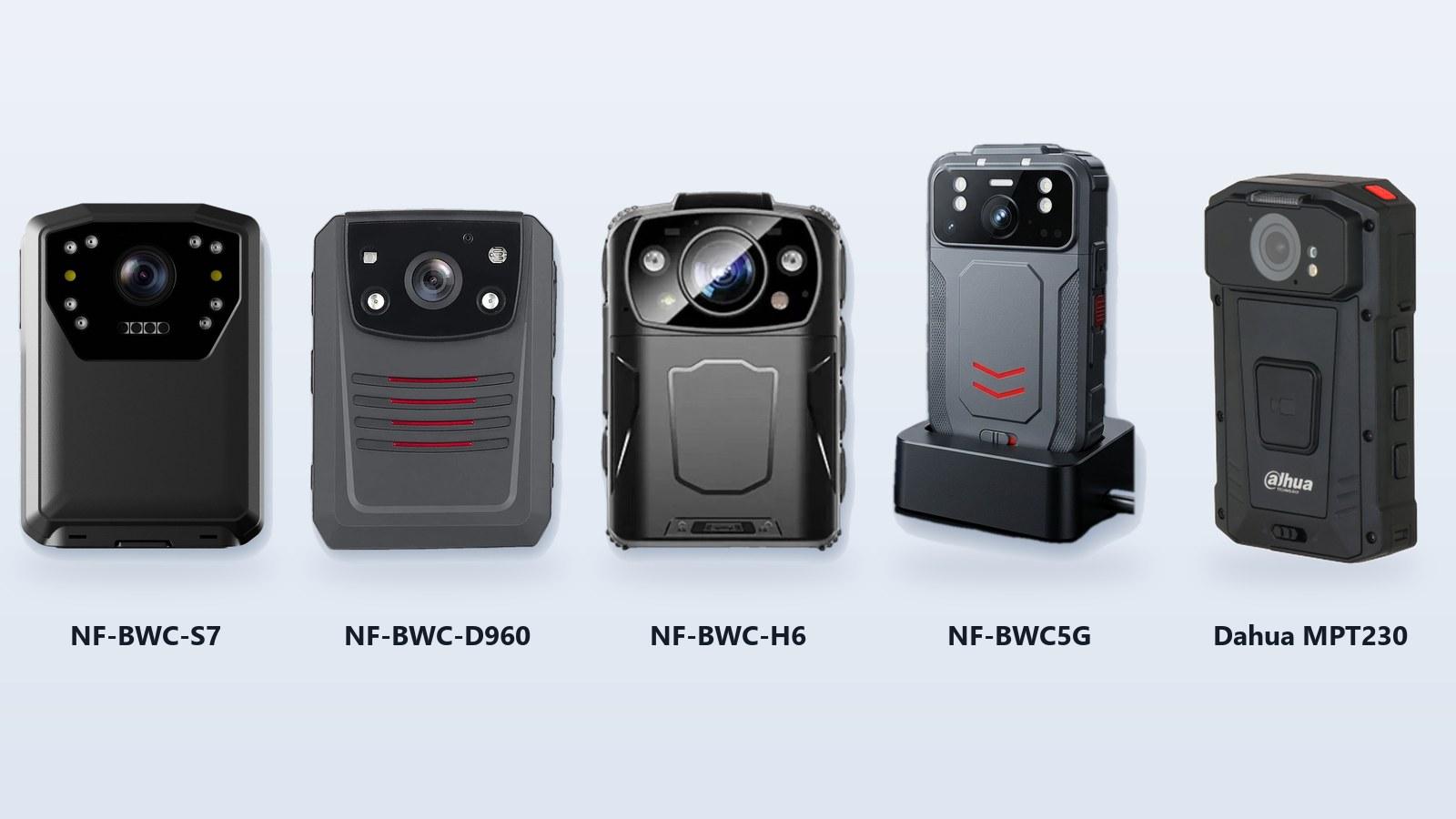
Note that these common clauses do not ask for 4G or live viewing. A camera that records locally and has its footage copied off at the end of the shift is therefore a workable starting point; consider a 4G model only if the office needs to see video, track location or talk to staff in real time. To compare options, see our 5 body-worn cameras compared: buying notes and the body-worn camera model comparison.
Who else uses body-worn cameras in Hong Kong?
Government front-line departments
| Department | Use | Since |
|---|---|---|
| Hong Kong Police Force | Front-line duties | Trials from March 2013; 1,336 cameras bought in 2015–2017; over 2,200 cameras by 2019 |
| Correctional Services Department | Incidents in institutions, escorts, recalling supervisees | Trial in 2015; about 700 cameras in 2019 |
| Food and Environmental Hygiene Department | Hawker control enforcement | Phased in from 3 July 2023 |
| Marine Department | Harbour Patrol Section | Full use from 1 July 2025 |
| Department of Health | Tobacco and Alcohol Control Office enforcement | From 20 August 2025 |
These departments follow broadly the same approach: cameras are worn openly; most state that, where reasonably practicable, people are told before recording starts; and footage with no investigative or evidential value is generally destroyed after 31 days. The Police and the Marine Department also state that members of the public can make data access requests under the Ordinance. Private organisations can use this as a reference when writing their own rules.
Common uses in the private sector
- Security patrols: recording patrols and handling disputes and incidents. The security industry is large: there were 365,016 valid Security Personnel Permits as at 30 June 2026.
- Property management: recording repair acceptance, common-area inspections and resident complaints. The Property Management Services Authority website shows 824 licensed property management companies.
- Contractors and subcontractors: besides the inspections required on public works, recording works, acceptance and safety briefings.
- Retail and customer service: keeping an objective record of disputes, although privacy and proportionality weigh even more heavily in public-facing settings.
There is no single law requiring private organisations to use body-worn cameras; whether and how to use them is for each organisation to decide based on its needs and privacy risks.
What privacy requirements apply to body-worn cameras?
Faces and voices captured by a body-worn camera are personal data under the Personal Data (Privacy) Ordinance. The PCPD's Guidance on the Use of CCTV Surveillance and its Guidance on the Use of Video Cameras on Drones and Vehicles, both issued in October 2025, are not written specifically for body-worn cameras, but their principles are a useful reference:
- Ask whether it is needed (Data Protection Principle 1): collect lawfully and fairly, for a directly related purpose, and no more than necessary. Carry out a privacy impact assessment first and consider less privacy-intrusive alternatives.
- Use clear notices: put a conspicuous notice on the camera, such as the bilingual "Video & Audio Recording In Progress", and tell people before recording where reasonably practicable.
- Do not keep footage longer than necessary (DPP2): the Ordinance sets no fixed number of days. Public works contracts commonly require at least 7 days of retention and deletion on completion; government departments generally destroy non-evidential footage after 31 days.
- Keep it secure (DPP4): limit who can view, copy and delete footage, for example with encryption, account permissions and access logs.
- Handle data access requests (DPP6): people who were recorded can ask for a copy of their footage, and organisations generally have to respond within 40 days of receipt.
This article summarises public information and is not legal advice; for specific situations, consult your legal adviser or the PCPD.
How can an organisation deploy body-worn cameras?
There are broadly three ways for footage to get from the camera to the office:
- Local recording: no SIM card or platform; footage is copied off by USB or memory card after the shift, e.g. NF-BWC-S7, NF-BWC-D960 and NF-BWC-H6.
- 4G live: the office can watch video, see positions and talk to staff in real time, e.g. NF-BWC5G (data SIM provided by the customer).
- On-site archiving: cameras are docked in a data collection station at the end of the shift to download and charge, and footage stays on site, e.g. Dahua MPT230 with EEC400-D.
Before deploying, we suggest four steps: first, check every clause of the contract's specification annex; second, choose the way the cameras will work; third, set the retention period, who may view footage and how it is handed over; and fourth, put up notices and train front-line staff to switch on, mark and hand over footage. New Forward can reply to your specification annex item by item and provides local warranty and operator training in Hong Kong.